Enochian Chess: The Complete Guide to Victorian Occult Chess
Update: I originally wrote this post to earn a chess.com achievement, but I thought it might be worth sharing here in a combined form. I also added some much needed SVG graphics. You’re welcome. Is this more understandable? I highly doubt it. But at least it’s more visible.
Chess variants are sometimes created and played in particular subcultures outside the chess community itself. Star Trek gave us Tridimensional Chess. Gary Gygax and the Dungeons & Dragons phenomenon spawned dragonchess. And the world of Victorian occultists, bless their elaborately robed hearts, gave us Enochian Chess.
The Origins
It was around 1887 (give or take a few astral fluctuations) when three gentlemen of dubious respectability founded the Hermetic Order of the Golden Dawn in London. One of them, Dr. William Wynn Westcott, was a coroner by trade and an occultist by disposition, which tells you something about Victorian England that the tourism boards prefer not to mention.
Westcott claimed the foundational documents of the Golden Dawn had been transmitted to him from a mysterious Fräulein Sprengel in Germany, representing an even older occult order. Whether this German connection actually existed or was (as seems rather more likely) a convenient bit of mythmaking to give the whole enterprise a patina of Ancient Authenticity™, we shall probably never know. The universe is not in the habit of answering such questions directly.
Westcott has been suggested as the inventor of Enochian Chess, but some (including Westcott himself) claimed the documents describing it were among those supplied from that older German group. The authorship remains unclear, at least partially because the Golden Dawn considered Enochian Chess to be a secret teaching. And secrets, by their nature, tend to be incompletely transmitted.
"Enochian" refers to the Biblical patriarch Enoch, father of Methuselah, who "walked with God" (Genesis 5:24) and "was taken from this life, so that he did not experience death" (Hebrews 11:5). In occult tradition going back to Queen Elizabeth I, Enoch is considered a source of hidden mystical knowledge. The variant was also called Rosicrucian Chess, after the Order of the Rosy Cross, a continental mystic fraternity from which the Golden Dawn claimed descent.
More specifically, the name refers to the magical system of Dr. John Dee, Elizabeth's court astrologer, who spent years conversing with what he believed were angels through a scryer named Edward Kelley.
Kelley was either a genuine medium, a spectacular con artist, or (and pay attention here, because this is the important bit) both at once. Reality tunnels, you understand, are not mutually exclusive. The angels gave Dee an entire language, a hierarchy of spirits, and enough diagrams to wallpaper a cathedral. Dee's diaries, preserved in the British Museum, remain objects of fascination and controversy four centuries later.
The Golden Dawn took this material and did what occultists always do: they systematized it, cross-referenced it with everything else (Kabbalah, Tarot, astrology, Egyptian mythology, and probably their breakfast menus), and eventually decided it needed a game.
Enter Enochian Chess: a variant designed for two or four players, wherein each player (or team) commands pieces corresponding to one of the four classical elements (Fire, Water, Air, and Earth). The pieces themselves were identified with Egyptian god-forms: Osiris as King, Isis as Queen, Horus as Knight, Aroueris as Bishop, and Nephthys as Rook.
The Invisible Partner
Documentary evidence for the game's existence (in the form of a Golden Dawn paper dating from no later than 1897) has come to light, but no historical documents discovered so far have given the complete rules for gameplay.
Nobel Prize-winning poet William Butler Yeats (yes, that Yeats) records in his memoirs that in 1894 he played "a curious form of chess at which there should be four players" with two other Golden Dawn members. One was MacGregor Mathers, a founding father of the order.
Westcott apparently never finished the rules. Mathers finalized the game around 1890, writing what Israel Regardie later called the "Official Ritual" describing piece movements. But Mathers was known for many things beyond rule-writing, including feuds with Aleister Crowley and playing Enochian Chess with what he called an "invisible partner," a spirit who occupied the empty chair across the board.
Joseph Hone, Yeats's biographer, described it thus: Mathers would shade his eyes with his hands and gaze at the empty chair before moving his partner's piece.
Let that image settle in your mind. A man in late Victorian London, playing a chess game derived from angelic communications, with a ghost as his teammate.
Was Mathers actually communing with spirits? Was he accessing his unconscious? Was he just very good at entertaining himself? I don't know. More interestingly, I'm not sure anyone can know from the outside.
In his book The Golden Dawn, Regardie provides a description of the boards and pieces, gives two arrays, and explains the occult methodology for deriving others. He attributes the movement rules to Mathers's "Official Ritual." But Regardie's publication lacked complete gameplay rules. For decades, people stared at these fragments, tantalized.
Which brings us to Chris Zalewski, who spent years in the 1980s reconstructing coherent rules from Regardie's publications, original manuscripts, and the Indian game Chaturanga (upon which the variant was based). When Regardie visited New Zealand in 1983, he was "astounded at the development to which Chris had taken the game."
The result was Enochian Chess of the Golden Dawn, first published in 1994, which remains the definitive text.
How To Play
The magical practices of the Golden Dawn are of no concern to the chess variant community. So says the Chess Variants website, and they're not wrong. You can play Enochian Chess purely as a game, ignoring every mystical attribution, and still find it strategically fascinating.
But isn't it more fun to know the weird stuff? I think so. Your mileage may vary.
Enochian Chess can be played on a standard FIDE 8x8 board, though Golden Dawn members did not use orthodox equipment. Play is facilitated by making the corner spaces at least twice as large as other squares, because those corners (the "throne squares") have special properties.
The four throne squares are a1, a8, h1, and h8. Remember them. They'll matter.
Divide the board conceptually into four quadrants: the fiery red of the Fire angle, the watery blue of the Water angle, the airy yellow of the Air angle, and the earthy black of the Earth angle.
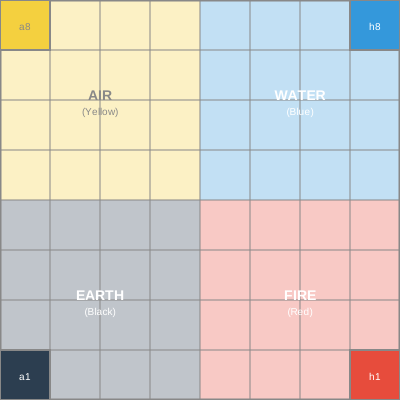
Place four armies upon this board, one in each corner. Each army consists of: a King (Osiris), a Queen (Isis), a Knight (Horus), a Bishop (Aroueris), a Rook (Nephthys), and four special Pawns.
The Teams
Teams are always fixed: Blue and Black versus Red and Yellow. There is no individual winner. If the blue army is eliminated but black captures both enemy kings, the blue-black team has won.
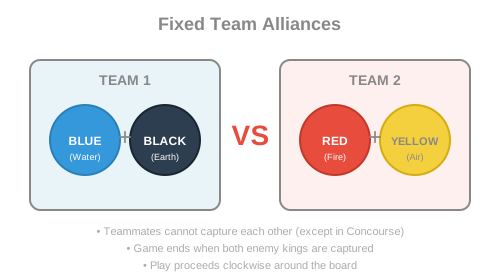
Teammates are normally forbidden from capturing each other's pieces (with one spectacular exception we'll get to). Allied pieces don't threaten each other. Blue and black kings can be adjacent without giving check.
Play proceeds clockwise around the board.
The Throne Square Problem
In all eight possible starting arrays, each throne square is occupied by two pieces: a King and one other piece (which piece depends on the array). This double occupancy is only allowed at the start. Once either piece moves, only one piece may sit on that throne square for the rest of the game.
And here's the brutal part: both pieces are captured if an enemy piece moves into a throne square while it's still doubly occupied.
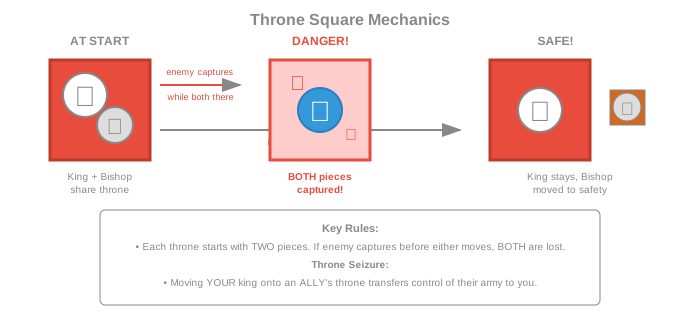
Your most important piece starts the game sharing space with another piece, and if you don't move fast enough, you lose both. This is not a game designed for the strategically timid.
The Eight Arrays
There are eight different starting configurations, each named by elemental combination: "Air of Air & Water," "Fire of Fire & Earth," etc. The array determines which piece shares the throne with each King.
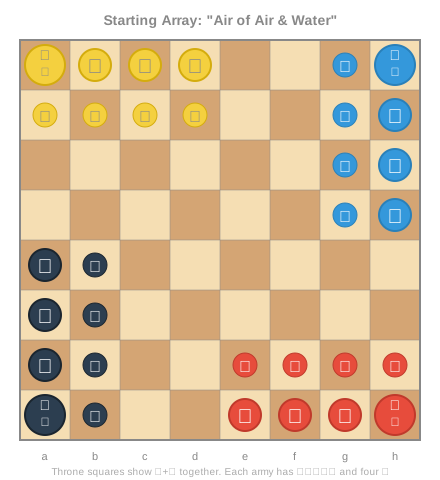
Regardie indicated sixteen possible arrays, but Zalewski concluded there are functionally only eight, since pairs like "Air of Fire" and "Air of Earth" have identical piece arrangements.
The choice of array also connects to which elemental board you're theoretically using:
- Air board: Yellow moves first
- Fire board: Red moves first
- Water board: Blue moves first
- Earth board: Black moves first
If playing on Fire or Earth boards, only "…of Fire & Earth" arrays may be selected. On Air or Water boards, only "…of Air & Water" arrays.
The Pieces
The King (Osiris) moves one square in any direction, same as standard chess. But kings are not mated in Enochian Chess. They are captured. You must declare "check" when threatening an enemy king. A king in check MUST be moved, even if that means putting it in check again. You may move another piece only if the king is completely blocked by friendly pieces.
The Queen (Isis) moves by leaping exactly two squares in any direction, orthogonal or diagonal, jumping over intervening pieces like an alibaba. She controls only 16 of 64 squares from any position, all of her own color.
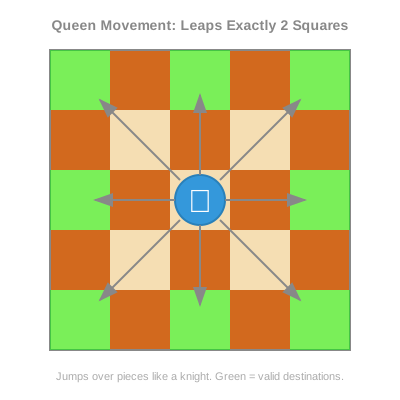
(The Chess Variants essayist speculates that in an earlier version the queen may have moved like a ferz, one square diagonally, and the bishop like an alfil, leaping two squares diagonally. But Regardie and Mathers both support Zalewski's leaping queen. Take your pick of which reality tunnel to inhabit.)
The Rook (Nephthys) moves orthogonally as in standard chess. No castling.
The Bishop (Aroueris) moves diagonally as in standard chess.
The Knight (Horus) behaves exactly as in standard chess.
The Pawns (the four Sons of Horus) move one square forward only, capturing diagonally forward. "Forward" differs by color: Yellow toward row 1, Blue toward column A, Red toward row 8, Black toward column H. No initial double step, no en passant.
Pawn promotion has restrictions: it only occurs after a player has lost at least one pawn. If all four survive, promotion must be delayed. And a pawn may only promote to its type: Pawn of Rook becomes Rook, Pawn of Knight becomes Knight.
When A King Falls
When a king is captured, all pieces of that color become frozen. They remain on the board but cannot move, don't threaten other pieces, and cannot be captured. They simply sit there as blocking terrain.
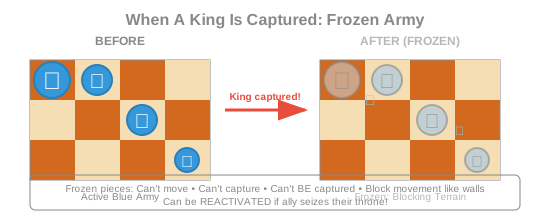
The game ends when both kings of one alliance have fallen.
Seizing The Throne
Moving your king onto the throne square of a friendly player transfers control of their army to you. Both armies still take separate turns, but you command both. Frozen pieces can be reactivated this way.
You retain control even if you later move the usurping king off the throne. But if your usurping king is captured, control reverts to the original player (assuming their army still has a king). Otherwise both armies are kingless and those players have lost.
Exchange Of Prisoners
Two opposing players who have both captured enemy kings may agree to exchange them. Both must agree, and neither can have lost their own king. Returned kings go on their throne squares (or nearest empty square). Frozen pieces revert to normal.
Zalewski doesn't indicate what happens if the throne is occupied and multiple alternative squares are equidistant. House rules, I suppose.
The Concourse
Opposing bishops are bound on opposite colors, so they can never capture each other normally. The Concourse of Bishoping is the exception.
By completing a 2x2 square formation involving all four bishops, the moving bishop captures all three others. This is similar to the "triumph of the boat" in Chaturanga for Four Players. It's the rare case where capturing a teammate's piece is legal.
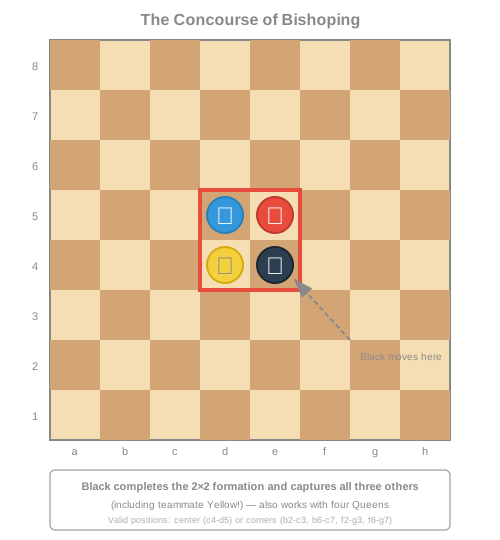
Unlike triumph of the boat, the concourse can only happen at five positions: the central squares (c4, c5, d4, d5) or the four corner clusters (b2-b3-c2-c3), (b6-b7-c6-c7), (f2-f3-g2-g3), (f6-f7-g6-g7).
The Concourse of Queens works identically. Bishops and queens cannot be combined; all four pieces must be the same type.
Privileged Pawn
If reduced to minimal forces (king and pawn, king-queen-pawn, or king-bishop-pawn), the pawn becomes "privileged" and can promote to any piece type, like a standard chess pawn.
However, if you promote to a piece type you already have, the original is demoted to a pawn of its type. Want a second queen? Your existing queen becomes a pawn of queen.
(What if you promote a pawn of queen to queen while having a queen? Zalewski is unclear. Presumably the original avoids demotion. Otherwise you'd be penalized for having privilege, which seems perverse even by Golden Dawn standards.)
Other Rules
Bare King Draw: Both teammates reduced to bare kings = draw.
Withdrawing: A player may withdraw at any time, leaving pieces to their teammate.
Stalemate: No legal move except putting your unchecked king in check = skip turns until another player's move alleviates it. Drawn if stalemated while teammate is also out.
Two Or Three Players
With fewer than four players, one or both command two armies. Each color still takes its own turn. A player operating both armies may not withdraw.
This is not simple. It models the complex, shifting, alliance-laden nature of… well, either elemental forces in an interactive universe, or just really interesting four-player dynamics. Depends on your preferred reality tunnel.
Why Bother?
Here's a question that has bothered philosophers since Plato: What is a game for?
The standard answer (entertainment, passing time, competition) explains chess clubs but not Enochian Chess. Nobody constructs a variant with Egyptian god-forms, throne-seizure mechanics, and concourse captures just to pass time.
Then again, maybe they do. Fun is underrated as a motive.
The Golden Dawn, however, had a specific additional answer: Enochian Chess subsumes other passive systems of divination and has "powerful prophetic properties."
Here's how divination worked: before the game, a question was formulated. A special piece called Ptah (the creative principle, "the Opener") was placed on a square corresponding to the query's nature. The game was played, and the outcome interpreted as the oracle's answer.
Think about what this means. Unlike Tarot, where cards are drawn randomly, or the I Ching, where yarrow stalks determine hexagrams, Enochian Chess divination is active. The querent participates. Strategy matters. Skill affects outcome.
The Golden Dawn claimed you could use the game "for practical ACTIVE divination, to alter and influence events as well as to simply predict."
Bold claim. Does it work?
I have no idea. Neither do you. But here's what I can say about the game's benefits, regardless of your metaphysical commitments:
The mechanics create situations you won't find elsewhere. The leaping queen. The throne vulnerability. The frozen armies becoming terrain. The concourse that can take your own teammate's piece. The prisoner exchange negotiations. You don't need to believe in anything to enjoy complex four-player dynamics.
The fixed alliance structure with throne-seizure, prisoner exchange, and withdrawal creates a simulation of complex multi-agent relationships. You might capture an enemy king, then be offered a prisoner exchange. Do you take it? Your ally might seize your throne if your king falls. Is that good or bad? These decisions model strategic thinking that most games don't require. You're coordinating with allies whose interests partially but not completely align with yours. Sound like anything in real life?
The Concourse can only happen at five specific positions. Four pieces from four players must converge into a 2x2 formation, and whoever completes it captures all three others, including their teammate's. You learn to see these configurations forming. You develop peripheral awareness of what's developing across the whole board, not just your immediate tactical concerns. Whether this trains you to see "elemental configurations" in daily life or just makes you better at complex board games, either way it's useful.
Mathers played with an invisible partner. Yeats reported games conducted with "Mathers, his wife, and a spirit." Was Mathers communing with actual disembodied intelligence? Accessing deeper unconscious layers? Randomizing moves through a process that felt like guidance? I don't know. The experience of sitting across from an empty chair, waiting for the move to become clear, does something to consciousness. Whether "something" involves angels, archetypes, or neurology is a question I leave to specialists.
What can be said: the game changes the player. It trains attention. It forces multi-perspectival thinking. It offers structured engagement with uncertainty that is neither passive reception nor anxious control.
And it's fun. Never discount fun.
The Modern Scene
Here's something that might surprise you: people are still talking about Enochian Chess.
A Chess.com forum thread from 2012 (still occasionally revived) contains this observation: "Enochian Chess is the Occultist's Chess. It can be used both for Competition AND Divination."
Someone replies: "I just purchased my 4 boards. Just currently learning how to actually play it."
And then the inevitable lament: "If someone set up a website to play Enochian chess online, I would 100% sign up."
The Chess Variants community has taken notice too. Their essay strips away mystical elements to present Enochian Chess as pure game mechanics, concluding diplomatically: "Golden Dawn practitioners may take this essay to task for the method of presentation used, whereby the mystical nature of Enochian chess has been stripped away wherever possible. No offense is intended. Nor is it the design of this essay to endorse or refute anyone's belief system. Enochian Chess has been submitted to the Chess Variant Pages so that it may take its rightful place in the broader outline of chess variant history."
This is exactly right. The game belongs to chess history as much as occult history. It sits alongside Star Trek's Tridimensional Chess and Gygax's Dragonchess as a variant born from a particular subculture.
Steve Nichols has been supplying Enochian Chess sets, books, and software since 1982, starting with support from Israel Regardie himself and a grant from the Prince's Trust. His Windows software allows one to four players to engage without constructing elaborate boards or carving Egyptian deities.
Nichols published a trilogy through Mandrake Press: Rosicrucian Chess of the Golden Dawn includes Moina Mathers's Alpha et Omega papers, play strategy, and Active divinatory methods. Celtic Chess presents Yeats's sixteen-board sub-elemental extension, developed with Maud Gonne and George Pollexfen from a notebook dated December 1898. Khemetic Chess (Hypermodern Magick) explores recent variants, Crowley's relationship to the system, and "No Self" Enochian Chess.
Modern practitioners have proposed Looney Pyramid adaptations, DIY approaches with "two cheapo chess sets and colored electrical tape," digital implementations, simplified two-player versions, and four-dimensional expansions.
Does the game work? As divination? I genuinely don't know. As entertainment? Absolutely. As training for complex multi-agent thinking? Yes. As something that changes how you perceive pattern and possibility? The people who play regularly say so. Whether that change is "magical" or "psychological" or "just getting better at a complicated game" depends on vocabulary preferences more than observable facts.
Getting Started
All right. You're either intrigued, confused, or both. Now you want to actually do something. Here's how.
The Chess Variants website confirms: "Enochian chess can be played on the 8x8 board of FIDE chess." You need two standard chess sets (thrift stores work), colored tape or paint (red, yellow, blue, black), a printed board diagram with enlarged corners, and a rules summary (free at chessvariants.com). Color-code your pieces by element. Mark your corners larger. You're playing. The traditional equipment (paper stand-ups with Egyptian god designs, four-triangle squares painted in elaborate color schemes) is beautiful but unnecessary for learning mechanics.
Alternatively, Steve Nichols' software makes the game "immediately playable" without physical construction. This solves the biggest problem: finding opponents who know the rules.
Or go full immersion: purchase Zalewski's book, construct proper boards, paint attributions, create god-form pieces. This takes months but is, in Golden Dawn tradition, part of the training. Or just use colored tape. The game doesn't care.
Pick "Air of Air & Water" for first games. It's most commonly illustrated. Remember: Fire or Earth board associations require "…of Fire & Earth" arrays. Air or Water boards require "…of Air & Water" arrays.
For the traditional starting procedure: select elemental board (determines who moves first), select compatible array, players throw dice and from highest to lowest each chooses their color. The Chess Variants essayist notes this seems odd: "The player who won the die roll gets the privilege of choosing which army to operate (and whether or not that player gets the first move), but the 'winner' is then at the mercy of others in regards to choosing a teammate." Poor game design? Or deliberate teaching about limits of individual agency? With the Golden Dawn, it's genuinely hard to tell.
Start with two players. Each controls two allied elements. Each color still takes its own turn, so you alternate. Graduate to four when you have friends who've learned the system. Or just play all four positions yourself while conversing with invisible partners. Mathers did.
Do you have to believe in magic? No. "The magical practices of the Golden Dawn are of no concern to the chess variant community." Many play Enochian Chess purely as an interesting four-player variant. The throne-seizure rules, concourse captures, and frozen armies create emergent situations unavailable elsewhere. The Egyptian gods are flavor. The game is the thing. (Though if you find yourself having unusually vivid dreams after extended play, or noticing "concourse formations" in workplace politics, don't say you weren't warned. Or don't attribute it to anything supernatural. Your call.)
Where to find opponents: Chess.com forums, Reddit's r/occult and r/GoldenDawn, chess variant communities, local esoteric study groups, or yourself with an invisible partner.
First games will be confusing. The Queen's leap takes adjustment. Four armies feels chaotic. Frozen pieces create strange board states. Fifth game: patterns emerge. Tenth game: you have opening preferences. Twentieth game: you understand why this has fascinated people for over a century. Whether that fascination is "mystical insight" or "appreciation for elegant game design" or "both" is entirely up to you.
The Deep End
You've learned the rules. You've played some games. The Queen's leap no longer surprises you. You've watched for concourse formations, protected your throne, maybe seized an ally's. Now you want to know what's underneath.
You don't have to look. The game works fine without it. But if you're the kind of person who wants to know why the manual has extra chapters, read on.
The Chess Variants website describes original equipment: "Enochian chess was traditionally played on one of four specially constructed boards. Each board represented one of the classical elements. Each square of each board was divided into 4 triangles, which were painted one of four different colors. These triangles were not game spaces themselves, merely components of the larger square cells used to play the game. Although confusing to the eye, an Enochian chessboard is functionally identical to a FIDE 8x8 board."
Read that again. Each square divided into four triangles. You're not looking at a flat surface. You're looking down at a truncated pyramid.
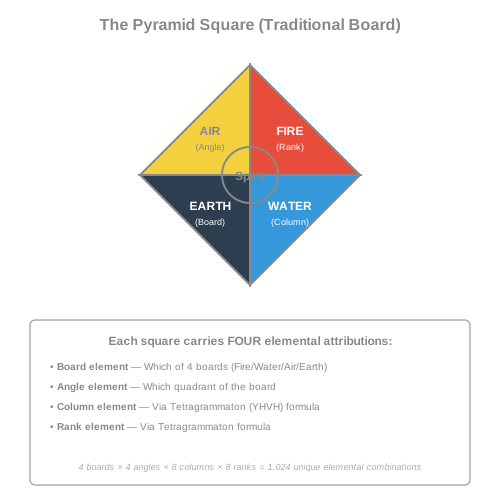
In Golden Dawn conception, each of the 64 squares is the apex of a four-sided pyramid extending into dimensions that ordinary geometry doesn't acknowledge. Each triangular face carries different attributions: the element of the board (red/Fire, blue/Water, yellow/Air, black/Earth), the element of the angle (the quadrant), a color from column position via Tetragrammaton formula, and a color from rank position via the same formula. The truncated top was left blank or marked with Spirit.
Every square carries four elemental attributions simultaneously, plus Spirit. Moving a piece isn't just changing location. It's navigating interpenetrating elemental forces. Or it's just moving a piece. Depends on how you want to think about it.
The four Hebrew letters YHVH (Yod-Heh-Vav-Heh) provide structure: Yod = Fire, Heh = Water, Vav = Air, Heh final = Earth. Columns and ranks cycle through this pattern. Every square has column and rank attributions combining with board and angle attributions. Fire of Water of Air of Earth. Sixty-four unique elemental combinations.
The traditional pieces were generally stiff paper stand-ups much like the paper dolls and paper toy soldiers of the era. Each major piece had a unique name and design taken from Egyptian mythology and all the pieces were painted in four-color paint schemes. Each mounted on a base colored for affiliation. Backs painted solid by type: Kings white, Knights red, Queens blue, Bishops yellow, Rooks black. Color-coding served practical and symbolic purposes. You could identify piece type from behind. Each piece carried elemental signature interacting with square attributions.
Interestingly, original boards did not include Enochian letters from John Dee's tablets, despite the game's name. Why? Because the chessboards derive from "Servient Squares" of the Angelic Watchtowers with binding structural elements removed. Without those binding forces, placing all Enochian letters would invoke "slightly chaotic" unbound angelic forces. The game was considered dangerous enough without that variable. (Or they just thought it looked cleaner. Hard to say with Victorians.)
Those five positions where Concourse can occur? They're not arbitrary. The central squares and four corner clusters represent specific configurations where elemental forces can combine catastrophically. Four pieces of the same type, from four different armies, converge into a 2x2 formation at these positions. The moving piece captures all three others. Alliances don't matter. Intentions don't matter. The configuration produces the effect. This is the Golden Dawn teaching: certain patterns have intrinsic power regardless of who creates them. It's also just good game design. Interesting emergent mechanics from simple rules. Both can be true simultaneously.
According to Zalewski, four approaches to construction: minimal (colors only, safest for beginners), Regardie's method (omit truncated pyramid top, four triangular faces carry attributions, center left plain), spirit-bound (add Spirit symbol to top, binding elemental forces), and full attribution (paint all planetary, zodiacal, and geomantic symbols, each board becomes complete magical diagram). Most use the first or second approach. The game works fine mechanically. But knowing the deeper structure exists changes how you think about what you're doing. Or doesn't. Your reality tunnel, your choice.
Even for pure materialists: the pyramid square system encodes multiple variables into single locations. Board identity (1 of 4), angle identity (1 of 4), column position (1 of 8), rank position (1 of 8). That's 4 × 4 × 8 × 8 = 1,024 unique combinations across 256 positions (64 squares × 4 boards). Modern game designers call this "information density." The Golden Dawn called it "correspondences."
When you capture an opponent's Knight on the Watery part of the Fiery angle of the Earth board, you're asserting dominance over a specific elemental configuration. Or you're just taking a piece. Or both.
If you want deeper understanding: learn Tetragrammaton correspondences, understand column/rank cycles, know which angle you're in, consider how pieces interact with square attributions. A Fire piece on a Water square may be weakened. An Earth piece on an Earth square may be strengthened. These correspondences can inform strategy. Or ignore all this and just play. The pieces don't actually care about their mythological names. They move the same either way.
What you make of the structure is up to you. The Victorians who designed this thought it mattered enormously. Modern chess variant enthusiasts think it's interesting historical flavor. Practicing occultists think it's technology disguised as entertainment. All three groups play the same game.
Closing
Whose move is it?
Whether anything is underneath besides wood and paint is your call. Whether the invisible partner is real is your call. Whether the pyramid squares matter is your call.
The game works either way.
If you’ve read this far, thanks for letting me confuse you. I don’t think my introduction was enough to make you fully understand the game, to be honest. Especially if you just read it and didn't actually tried to play it. And there are different varieties of the game itself too. So yes, the title was a lie.
Sources
- Zalewski, Chris. Enochian Chess of the Golden Dawn. Llewellyn Publications, 1994. Amazon
- Regardie, Israel. The Golden Dawn. Llewellyn Publications, 1937/1989.
- Nichols, Steve. Rosicrucian Chess of the Golden Dawn. Mandrake Press, 2017.
- Nichols, Steve. Celtic Chess. Mandrake Press, 2019.
- Nichols, Steve. Khemetic Chess. Mandrake Press, 2022. Mandrake
- Chess Variants: Enochian Chess
- Chess.com Forum: Enochian Chess Discussion
- BoardGameGeek: Enochian Chess
- Wikipedia: Enochian Chess
- Looney Pyramids Wiki: Rosicrucian Chess